


Quick Summary
Click here for Price and Turnaround Time
Phenotype: Cats affected by hypertrophic cardiomyopathy (HCM) are at risk of sudden cardiac death. Ragdoll cats with two copies of the disease-associated mutation are at high risk of developing severe signs of HCM, usually between 1-2 years of age, and have a greater likelihood of early cardiac death. Cats that carry one copy of the mutation are not likely to show signs of the disease and may live a normal lifespan.
Mode of Inheritance: Autosomal dominant (incomplete penetrance)
Alleles: N = Normal, HCMrd = hypertrophic cardiomyopathy-associated mutation
Breeds appropriate for testing: Ragamuffin, Ragdoll and related outcrosses. This variant has also been detected in the American Bobtail (Longhair), Highlander and Munchkin.
Explanation of Results:
- Cats with N/N genotype are not predicted to be at increased risk of HCM and cannot transmit this hypertrophic cardiomyopathy-associated mutation to their offspring.
- Cats with N/HCMrd genotype may be at increased risk of HCM. They will transmit this hypertrophic cardiomyopathy-associated mutation to 50% of their offspring.
- Cats with HCMrd/HCMrd genotype are at high risk of developing HCM, a potentially fatal condition.
Cat DNA tests are carried out using cells brushed from your cat's cheeks and gums using household cotton swabs.
The cat DNA submission form with instructions and a place to tape the cotton swabs is sent to you via email after you place an order, and can be printed from your home computer. DNA test kits are no longer mailed.
Instructions
Step-By-Step:
1.
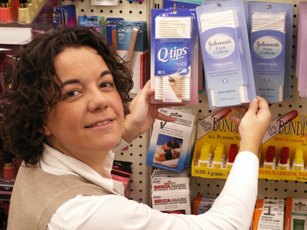 Purchase regular household cotton swabs for cat DNA collection (the cotton swabs can be purchased at a pharmacy or drug store)
2.

Make sure the cat has not had anything to eat or drink for at least 1 hour prior to collecting sample.
When swabbing kittens, isolate each kitten from the mother, littermates and any shared toys for 1 hour prior to swabbing. Kittens should not have nursed or eaten for 1 hour prior to collecting sample.
If collecting samples from more than one cat, make sure to sample one cat at a time and wash your hands before swabbing another cat.
3.
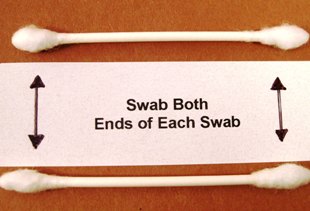 Use both ends of the two cotton swabs for a total of four swabs.
4.
Place the cotton head of the swab between the cat’s gums and cheek and rub or rotate the swab back and forth for 15 seconds. Repeat with each cotton swab head, for a total of 4 swabs. We recommend swabbing a different area of the gums with each swab head.
5.
Wave the swab in the air for 10-15 seconds to air dry it before attaching it to the submission form.
6.
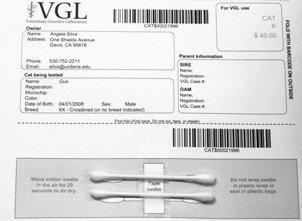 After swabbing the cheek and gums, tape the cotton swabs to the bar-coded submission form printed from your MyVGL account.
ATTENTION:
- Do not collect saliva/drool – the key to obtaining a good sample is getting cheek cells on the swab.
- Do not rub swab on the cat’s tongue or teeth – this will result in poor quality sample.
- Do not collect a sample from a kitten that has recently nursed – the mother’s genetic material can rub off on the kitten’s mouth and contaminate the sample.
Hypertrophic cardiomyopathy is the most common cardiac disease in cats. Affected cats are at risk of sudden cardiac death due to defects that produce increased left ventricular heart muscle thickness. In Ragdolls, the condition is inherited due to breed specific mutations in the cardiac myosin binding protein C gene (MYBPC3).
The Ragdoll HCM mutation, known as R820W, is a single base pair change in MYBPC3 that is thought to alter the shape and function of this essential protein for normal heart muscle development. The same R820W mutation has been found to be associated with HCM and left ventricular non-compaction in humans (see reference below, Ripoll et al. 2010). Recent studies show cats that are heterozygous (1 copy) for the mutation are not likely to show signs of the disease and may live a normal lifespan. Homozygous (2 copies) cats for the mutation are at high risk of developing severe HCM signs, usually between 1-2 years of age and have a greater likelihood of early cardiac death. Infrequently, homozygous cats do not show clinical signs of HCM.
Breedings between 2 heterozygous cats are expected to produce 25% high risk kittens. It is not recommended to use cats homozygous for the R820W mutation in a breeding program.
Testing for the Ragdoll HCM mutation to helps owners and breeders identify the Ragdoll HCM status of their cats.
Note: This test only detects the R820W mutation associated with HCM in Ragdoll cats and outcrosses as described by Meurs et al. 2007. The VGL offers a separate test for the A31P mutation associated with HCM in Maine Coon cats.