The modern-day domestic cat displays a wide variety of coat colors and patterns. Classification of these can be confusing sometimes because different registries or associations may name the same phenotype differently. Below is a table of the coat color genes and DNA tests offered by the Veterinary Genetics Laboratory.
Procedure for collecting a feline DNA sample
SUBMISSION FORM - Allow 2-6 business days for test results
| GeneName | Symbols | Function | Wild type |
| Agouti | A, a | Non-agouti, aa, cats are solid (self) in color. Tabby patterns are difficult to identify. | A |
| Amber | E, e | Gradual replacement of eumelanin with phaeomelanin, in Norwegian Forest cats. | E |
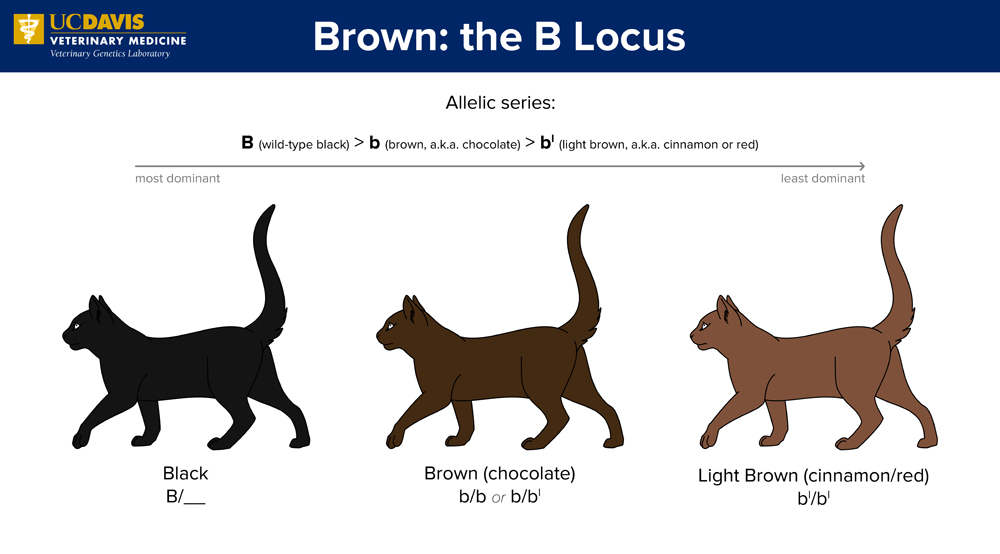
| Brown | B > b > bl | Brown variants have reduced eumelanin and appear brownish in color. b/b and b/bl are chocolate, bl/bl are cinnamon (red). | B |
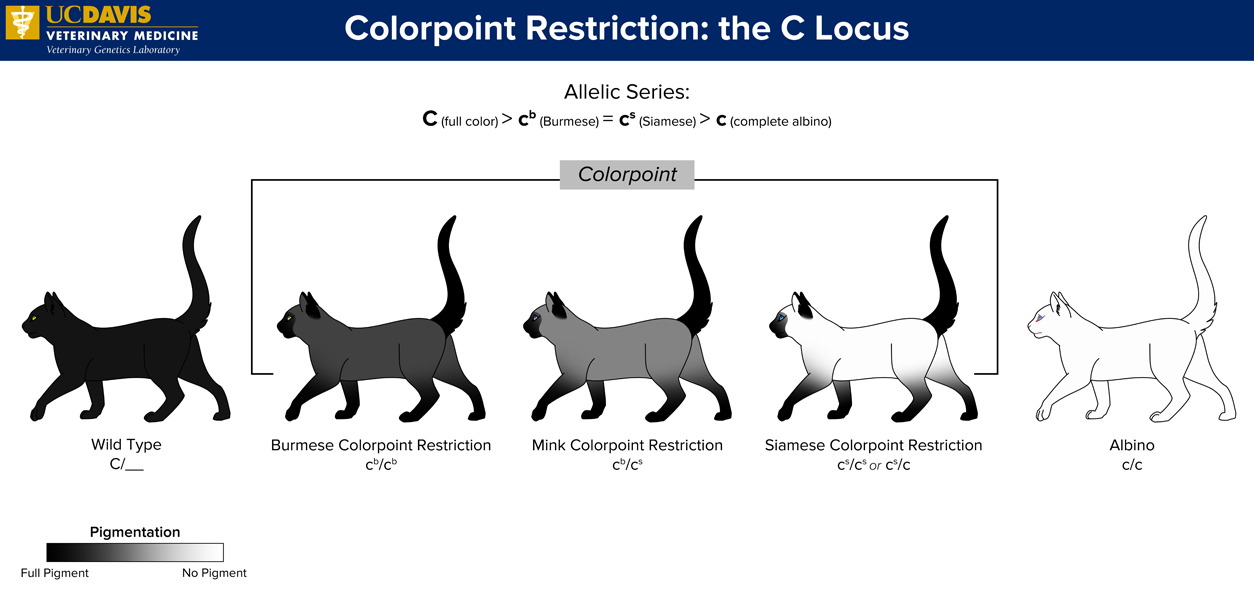
| Colorpoint Restriction | C > cb = cs> c | Color controls production of melanin. Temperature sensitive alleles create points and sepia. Complete albinos have been identified. | C |
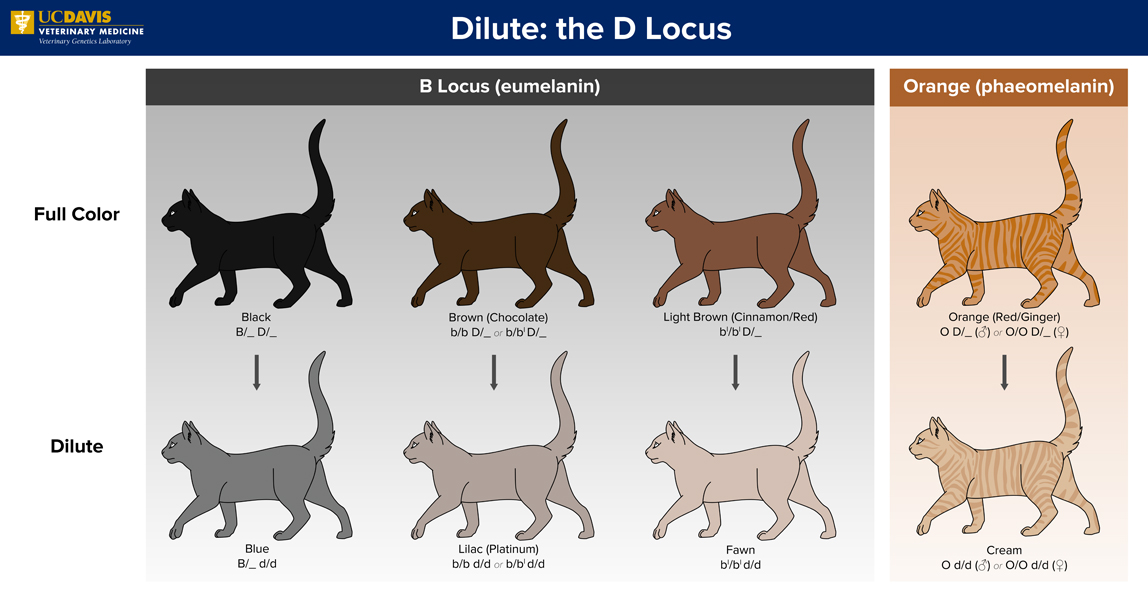
| Dilution | D, d | Dilution causes uneven distribution of the pigment in the fur shaft, dilution of all colors. | D |
| White Gloves | G, N | Birman white gloving pattern | N |
For additional information on the genetics of coat color/patterns in cats, please consult the references given below and visit Dr. Leslie Lyon’s web page The Lyons' Den
Agouti
The Agouti (agouti signaling protein, ASIP) gene produces a protein that regulates the distribution of black pigment (eumelanin) within the hair shaft. The wild type allele A is dominant and produces hair shafts with alternating bands of yellow and black color, ending with black tips (similar to the coat of a wild mouse or rabbit). The recessive allele a produces a cat that is self-colored (solid) when 2 copies of a are present. Another system of pigmentation in cats produces the tabby patterns of dark stripes interspersed with the lighter agouti tipped hairs. Hairs in the darker stripes do not have the shift between black and yellow pigment production and remain uniformly dark. The effect of the agouti protein on orange pigment is limited, thus tabby striping may still be seen on cats that are a/a for agouti.
Results reported as:
A/A: Homozygous for agouti. All offspring will have agouti banded hair.
A/a: Heterozygous for agouti. Offspring can be agouti or non-agouti depending on the genetics of the mating.
a/a: Homozygous for non-agouti (solid colored). If bred to a non-agouti, only non-agouti offspring will be produced.
Albino
Two mutations in the Tyrosinase (TYR) gene produce the Burmese (sepia), Siamese and mink colorpoint coat and eye color phenotypes in cats. A rare mutation in TYR produces an albino phenotype of a white coat with blue eyes. The albino mutation is recessive to the sepia and Siamese mutations. The VGL offers a test for this albino mutation.
Results reported as:
N/N: No copies of albino allele are present.
A/N: 1 copy of the albino allele is present
A/A: 2 copies of the albino allele are present. Cat is albino.
Amber – Norwegian Forest Cat
In cats, shades of red color are determined by the dominant Orange gene located on the X chromosome. However, in some Norwegian Forest Cats, there is a recessive mutation in the MC1R gene that results in kittens that are born with a black/brown tabby pattern (blue/apricot in dilute cats). As the kittens mature, the black/blue pigment is replaced by yellow resulting in the golden coat coloration seen in adult cats. This mutation traces back to a single female ancestor from Norway born in 1981 and the color, originally named X Colour, is now called Amber. Display of the Amber coloration depends on the presence/absence of dominant Orange. In the absence of Orange, males and females with genotype e/e will have the Amber coloration. Amber males that have the Orange gene will be red. Amber females that have one copy of the Orange gene will be amber/red tortoiseshell. Amber females with two copies of the Orange gene will be red.
Results reported as:
E/E: No copies of the mutation for Amber.
E/e: 1 copy of the Amber mutation. If bred to another carrier, 25% of the kittens will be Amber (in the absence of Orange)
e/e: 2 copies of the Amber mutation. Cat will be Amber colored (in the absence of Orange)Brown (chocolate and cinnamon)
The Brown (tyrosinase-related protein-1, TYRP1) gene affects the amount of black (eumelanin) pigment produced. Mutations responsible for brown and cinnamon colors in the cat have been identified in this gene. The wild-type B allele produces normal, black coloration. The b allele produces the brown (chocolate) phenotype and the bl allele produces a light brown or cinnamon phenotype. These form an "allelic series" with B dominant to b, and b dominant to bl.
Results reported as:
B/B: Full color, cat does not carry brown or cinnamon
B/b: Full color, carrier of brown
B/bl: Full color, carrier of cinnamon
b/b: Brown
b/bl: Brown, carrier of cinnamon
bl/bl: Cinnamon
Colorpoint Restriction (Color)The Tyrosinase (TYR) gene, also known as the Color gene, produces an enzyme that is required for melanin production. Mutations in TYR have been associated with temperature-sensitive pigment production that results in colors known as Burmese and Siamese. The wild type phenotype is full color. The Burmese phenotype results from reduced pigment production changing black pigment to sepia and orange to yellow. The Burmese points are darker than the body and the eyes are yellow-gray or yellow-green. The Siamese phenotype reduces pigment production to the points and the eyes are blue. The wild type (C) allele is dominant to Burmese (cb). Burmese is incompletely dominant to Siamese (cs); Burmese and Siamese heterozygotes (cb/cs) are intermediate in color (mink).These tests identify carriers of Burmese (also called sepia) and Siamese pointed coloration.
A very rare allele of TYR produces an albino phenotype with white coat and blue eyes. The current tests do not detect this rare form.
Results reported as:
C/C: Full color, cat does not carry Burmese (sepia) or Siamese alleles
C/cb: Carrier of Burmese (sepia) color
C/cs: Carrier of Siamese colorpoint restriction
cb/cb: Burmese (sepia)
cs/cs: Siamese
cb/cs: Mink, intermediate color between Burmese (sepia) color and Siamese pointed phenotypes
NOTE: Colorpoint Restriction Test for Bengal and Savannah Cats
A Colorpoint Restriction Gene test specific for domestic/wild hybrid cats has been developed by VGL. African Serval and Asian Leopard Cat DNA sequences can interfere with our standard Colorpoint Restriction Gene test for domestic cats. Please allow 10-15 working days for results of Colorpoint testing in hybrid cats. There is no additional cost for this test.
The dilute gene (Melanophilin or MLPH) causes clumping and uneven distribution of pigment granules in the hair shaft, producing dilution of all coat colors. Dilute is an autosomal recessive trait which means that two copies of the dilute allele are needed to produce the phenotype. Black pigment is diluted to gray (blue is the term used by cat breeders), and red is diluted to cream. The wild type allele is non-dilute. Some cat breeds are fixed for the wild type, such as Egyptian Mau and Singapura, while others are fixed for dilute such as Chartreux, Korat and Russian Blue. Most other breeds have both wild type and dilute alleles.
VGL offers a test for the dilute gene. This test is useful to identify carriers of dilute and to determine the genetic type for young animals that may have yet to develop their adult coloration.
Results reported as:
| d/d | Two copies of dilute allele. Coat color is diluted. |
| D/d | One copy of dilute allele. Cat is a carrier of dilute. |
| D/D | Full color. Cat does not have the dilute allele. |
Sections reprinted with permission of: Leslie A. Lyons Ph.D., Associate Professor, Department of Population Health and Reproduction, University of California, Davis.
White Gloves – Birman Pattern
Birman cats must have clearly defined white feet as part of their breed standard. Recent research by Dr. Gandolfi in the Lyons’ feline genetics laboratory at UC Davis has identified a mutation in the KIT gene that is associated with the gloving pattern characteristic of Birman cats. Gloving is inherited as an autosomal recessive trait, thus a cat must have two copies of the mutation in order to have the gloved white feet. This mutation is virtually fixed in Birman cats, implying all Birmans have two copies. Birman outcrosses have one copy as they are carriers, and the mutation is found at a low frequency in the other breeds that have been tested, including Ragdoll, Egyptian Mau, Exotic Shorthair, Maine Coon, Manx, Seychellois, Siamese, Siberian, Sphynx and Turkish Van.
Birmans should have two copies of the mutation thus the test could be used to help distinguish Birmans from mitted Ragdolls. Research has shown that while the Birman gloved mutation can be found in Ragdolls, most mitted Ragdolls lack this mutation. Thus, Birmans can be distinguished from mitted Ragdolls with a genetic test for this KIT mutation.
The VGL has developed a genetic test for the Birman gloving pattern mutation. The tests use DNA collected from buccal swabs thus avoiding invasive blood collection.
Results reported as:
N/N: Normal, cat does not have gloving.*
N/G: Carrier, cat has one copy of gloving mutation.
G/G: Gloved
* This test is specific for the KIT mutation found to be associated with gloved white pattern typical of Birman cats. It does not detect other mutations that also cause gloving but which have not yet been identified.
Reference:
B Gandolfi, LH Bach, et al. Off with the gloves: Mutation in KIT for the unique white spotting phenotype of Birman cats. Submitted for publication.