


Quick Summary
Click here for Price and Turnaround Time
Phenotype: Cats affected by PK deficiency develop anemia. The anemia is intermittent, the age of onset is variable, and clinical signs are also variable. Symptoms of this anemia can include severe lethargy, weakness, weight loss, jaundice, and abdominal enlargement.
Mode of Inheritance: Autosomal recessive
Alleles: N = Normal, K = PK deficiency
Breeds appropriate for testing: Abyssinian, Australian Mist, Bengal, Domestic Shorthair and Longhair, Egyptian Mau, La Perm, Maine Coon, Norwegian Forest, Savannah, Siberian, Singapura, Somali, Toyger
Explanation of Results:
- Cats with N/N genotype will not have PK deficiency. They cannot transmit this PK deficiency variant to their offspring.
- Cats with N/K genotype will not have PK deficiency, but are carriers. They will transmit this PK deficiency variant to 50% of their offspring. Matings between two carriers are predicted to produce 25% PK deficiency-affected kittens.
- Cats with K/K genotype will have PK deficiency; severity of symptoms cannot be predicted and may be variable. They will transmit this PK deficiency variant to all of their offspring.
$47 one test per animal
Also available as part of the following packages:
- $71 this test + Bengal PRA-b test (valid for Bengals only)
- $71 this test + PRA CEP290 test or PRA CRX test (Abyssinian, Somali, and domestic shorthair)
- $95 this test + PRA CEP290 test + PRA CRX test (Abyssinian, Somali, and domestic shorthair)
Cat DNA tests are carried out using cells brushed from your cat's cheeks and gums using household cotton swabs.
The cat DNA submission form with instructions and a place to tape the cotton swabs is sent to you via email after you place an order, and can be printed from your home computer. DNA test kits are no longer mailed.
Instructions
Step-By-Step:
1.
 Purchase regular household cotton swabs for cat DNA collection (the cotton swabs can be purchased at a pharmacy or drug store)
2.

Make sure the cat has not had anything to eat or drink for at least 1 hour prior to collecting sample.
When swabbing kittens, isolate each kitten from the mother, littermates and any shared toys for 1 hour prior to swabbing. Kittens should not have nursed or eaten for 1 hour prior to collecting sample.
If collecting samples from more than one cat, make sure to sample one cat at a time and wash your hands before swabbing another cat.
3.
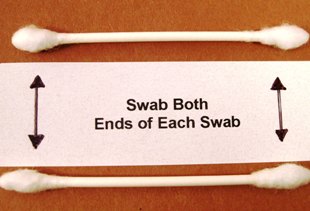 Use both ends of the two cotton swabs for a total of four swabs.
4.
Place the cotton head of the swab between the cat’s gums and cheek and rub or rotate the swab back and forth for 15 seconds. Repeat with each cotton swab head, for a total of 4 swabs. We recommend swabbing a different area of the gums with each swab head.
5.
Wave the swab in the air for 10-15 seconds to air dry it before attaching it to the submission form.
6.
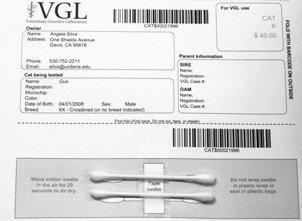 After swabbing the cheek and gums, tape the cotton swabs to the bar-coded submission form printed from your MyVGL account.
ATTENTION:
- Do not collect saliva/drool – the key to obtaining a good sample is getting cheek cells on the swab.
- Do not rub swab on the cat’s tongue or teeth – this will result in poor quality sample.
- Do not collect a sample from a kitten that has recently nursed – the mother’s genetic material can rub off on the kitten’s mouth and contaminate the sample.
Erythrocyte pyruvate kinase deficiency (PK deficiency) is an inherited hemolytic anemia caused by insufficient activity of this regulatory enzyme which results in instability and loss of red blood cells. The anemia is intermittent, the age of onset is variable, and clinical signs are also variable. Symptoms of this anemia can include severe lethargy, weakness, weight loss, jaundice, and abdominal enlargement. This condition is inherited as an autosomal recessive.
Testing for PK deficiency assists owners and breeders in identifying affected and carrier cats. Breeders can use this test as a tool to avoid breeding carriers together, which would produce 25% affected offspring.
Based on a survey of 38 breeds, the mutation responsible for PK deficiency has been found in significant frequency in Abyssinian, Bengal, Domestic Shorthair and Longhair, Egyptian Mau, La Perm, Maine Coon, Norwegian Forest, Savannah, Siberian, Singapura, and Somali. Cats of these breeds are at higher risk of having PK deficiency or producing affected offspring; genetic screening for the mutation is recommended. A few breeds showed very low frequency of the mutation (less than 0.2%) and are low risk: Exotic Shorthair, Oriental Shorthair, and Persian.